
The greatest trick the UK government played was persuading the Scottish government that the economic power lay in Holyrood.
Well done, Jim Fairley. On BBC’s Debate Night (a production I have never had the ‘pleasure’ of watching in full), the MSP for Perthshire South and Kinross-shire stuck his head above the parapet:
we are in the constitutional position where the big decisions that we want to make in this country are curtained on the basis of the decisions elsewhere
The elsewhere is London.
Jim was responding to a question about growth. In essence, he said that the Scottish government does not have the power to create growth because the economic levers lie in London.
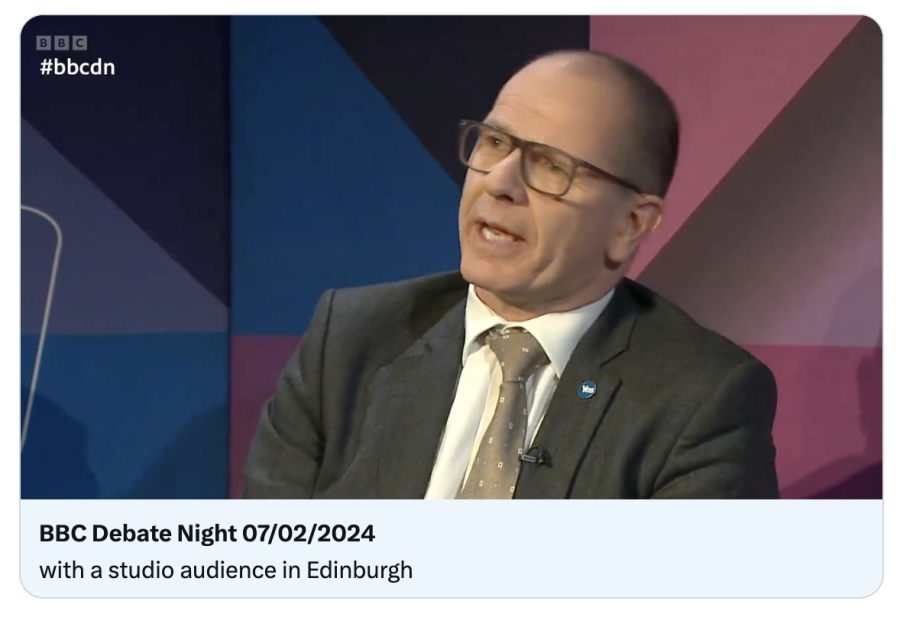
For many people, this is a statement of the bloody obvious. The Scottish government are currency users like you and me, and for example, has fewer borrowing powers than one of its Local Councils!
However, the Scottish government has almost totally whitewashed this narrative from official reports and papers. Statements like this are also very rare indeed.
As we have outlined in several articles, including this one recently for Bella Caledonia, Scotland cannot have the capacity to grow the economy way above trend while at the same time lacking the resources to create a Department of Industrial Policy. This is not economically consistent. So which one is it? It has the power or it doesn’t?
Jim says it straight. It doesn’t have the power. But this is not the official party line.
The National Strategy for Economic Transformation (2022) says that the Scottish government has a target for GDP growth that “significantly outperforms the last decade.”
In what could be seen as some obvious gaslighting, the report then lists five areas where it may be hampered, and I quote:
- The Scottish Government can not directly effect change in the labour market is limited as long as employment law remains reserved
- Without migration powers we cannot design and implement an immigration system to address our demographic challenges
- Any macro-economic powers
- Any energy policies
- And the majority of revenue-raising powers
But don’t fret! This exceptionally bold target will be achieved “by concentrating on current successful industries and growing industries with potential”. It is worth highlighting that this report was authored by Kate Forbes.
At the time of reading this paper, back in 2022, it was never going to pull the wool over any critical eye.
Time to get back to a much more challenging stance
No doubt, scared of the “winging jocks, always blaming Westminster” calls, someone at some point told their colleagues to drop the complaining and start talking up their powers. This was a monumental mistake. As any political strategist will tell you, never ever take responsibility if you do not have the authority. But this is exactly what the Scottish Government has been doing for more than a decade. All the responsibility and hardly any of the powers.
The Scottish government’s Chief Economist is a non-political civil servant who is happy to say it out loud. You can watch a fantastic 40-minute interview with Gary Gillepsie here. Gary says,
While macroeconomic powers are limited, Scotland wields significant microeconomic levers like skills, innovation, and infrastructure investment. We’re quite active in local economic development, sectoral support, and enterprise facilitation.
So, nothing more than tweaks when it comes to growth.
It would be a significant and important change of tact if MSPs, MPs and Scottish Government policy papers made it clearer that the UK holds all the purse strings and Scotland has no macroeconomic powers. It would be a bonus if they added that under the current plan, this would continue well after independence – check out our little quiz if you want to see where those macroeconomic powers will lie AFTER independence according to the current plan.
So we must ask how the Scottish government can create reports that promise the earth and expect to have serious economic credibility.
It seems that the ‘Usual Suspects’ in the Scottish government are too scared to point the finger at Westminster.


