
Assuming that governments are financially constrained—rather than resource-constrained—stymies the climate response.
Given the urgency with which states must mobilise to mitigate and adapt to the ecological crisis, we must develop and share a better understanding of government finances if we are to secure a prosperous future.
Economist Stephanie Kelton uses the phrase ‘learned helplessness’ to describe the self-imposed, ideological constraints that governments that issue and tax in their currency, have minimal foreign currency debt, and operate a floating exchange rate, place on their spending. Nowhere is this more obvious than in state action to mitigate and adapt to our ecological crisis.
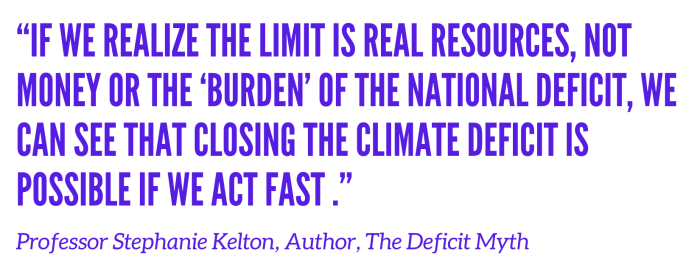
‘Learned helplessness’ – assuming that governments are financially constrained stymies the climate response
The conventional wisdom of neoclassical or neoliberal economics suggests that governments should run a balanced budget in the medium term, borrow from the ‘markets’ if spending commitments exceed tax revenue, and curtail high debt repayments to avoid insolvency.
In essence, the mainstream treats a currency-issuing government much like a household. Within this framing, we can only afford to solve our ecological crisis if we can raise finance from the private sector.
Modern Monetary Theory (MMT) rejects this position. It discusses fiscal space—the ability of governments to issue currency and spend on the public purpose—not in monetary terms but in functional terms.
The question is not where to find the money, but whether the government has:
“available real resources that can be brought back into productive use” (Mitchell 2020: 3).
This is the core insight of MMT, and it highlights that fiscal space is much larger than mainstream economists, policymakers, commentators, and the public believe.
With MMT providing a framework for increased fiscal space, the question arises: Why is the climate movement not demanding a larger central-government spending response to the ecological crisis?
The climate movement
Part of the answer is that many people within the climate movement are unaware of MMT or have been exposed only to the mainstream straw man of ‘printing money’ and ‘magic money trees’.
Whatever the reason, the climate movement is not yet capitalising on the work by MMT academics to demand the allocation of rapid and substantial funding for climate and nature adaptation and mitigation.
The connection between MMT and government-funded climate finance is clear. If access to finance isn’t the main constraint for Global North nations, and the Global South is much less financially constrained, this would empower the climate movement to demand faster and more substantial government action worldwide.
An extension of fiscal space would enable the implementation of large public works, a Green New Deal, a Job Guarantee, and support for a care economy.
It would also enable a very different approach to climate finance, which is generally governed by a neoliberal framework that prioritises the private sector (Bracking & Leffel 2021).
The climate movement finds a natural economic ally in MMT
MMT highlights that almost all nations have more fiscal space (AKA government spending power) than they are currently using.
It is the ‘learned helplessness’, powered by conventional wisdom that restricts state funding, including low levels of expenditure in response to the ecological crisis; for example, only 51% of European cities have climate adaptation plans (World Meteorological Organisation 2025).
Mainstream economic assumptions that falsely assume governments are financially constrained—rather than resource-constrained—stymie the climate response.
The evidence that governments have greater fiscal space is as clear as the science informing the need to respond to the climate crisis.
References:
Bracking, S. and Leffel, B. (2021). ‘Climate finance governance: Fit for purpose?’, WIREs Climate Change, 12, e709.
Mitchell, W. (2020). Working Paper No. 20-05. Centre of Full Employment and Equity. Available at: https://www.fullemployment.net/publications/wp/2020/wp_20_05.pdf
World Meteorological Organization (2025). European State of the Climate: Extreme Events in Warmest Year on Record. Available at: https://wmo.int/news/media-centre/european-state-of-climate-extreme-events-warmest-year-record


