
Food and drink exports have increased by 7% in the last decade. But look behind that figure and you see a very different story about Scotland’s exports.
A ‘story’ emerged at the end of May about Scotland’s food and drink exports. The Herald picked up on the story, but I couldn’t see it anywhere else (apart from various threads, etc, on X). I assume it was a story released by the SNP.
The headline was that Scotland’s exports in food and drink were six times those of England per capita. Here’s an image from an MSP’s page on Facebook:
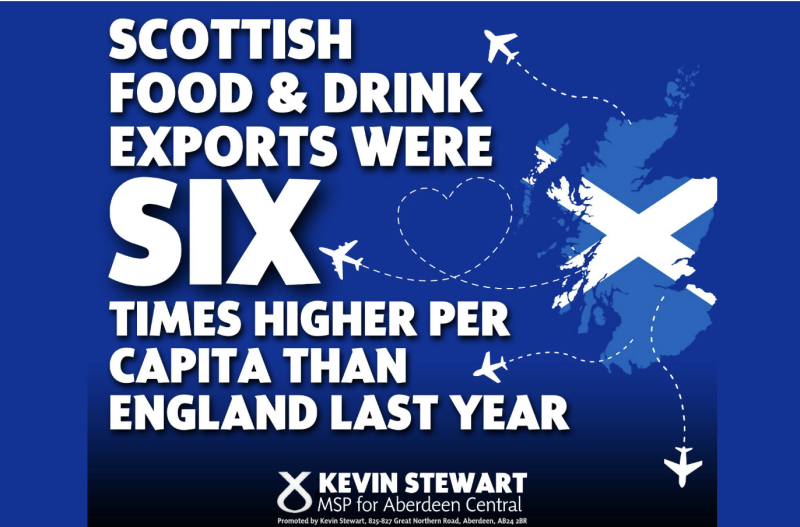
And the economic value of this narrative is what exactly?
As far as I can tell, the figures are from this report released in September 2024. Perhaps it’s a story…but it’s certainly not news!
I am no spin doctor, but it looks like the SNP sent this ‘story’ out, and many MSPs were happy to amplify. There’s nothing wrong with this, of course, and all parties will do this: it is like a band deciding not to do the new single and pull out one of the classics.
It is great “PR” from a Scottish Government perspective. It does three things:
- It says that food and drink exports continue to do well
- It suggests that Brexit was a bad decision and
- Rejoining the EU is central to the success of an independent nation
You may or may not agree with some or all of these policies (more on this below), but that argument aside, what I found weird was the framing of Scotland v England.
I asked Robin McAlpine what is going on with this approach. He had this to say,
“In Scotland, one side of the constitutional debate shouts about one set of statistics and visa versa, but this is just PR and has nothing whatsoever to do with actual economic policy-making and involves no interrogation of whether the statistics actually show things are healthy with our economy.”
Is that right?
What was the point of this? Does it matter one jot that we export 6 x more food and drink than England? Of course it doesn’t! Why is this how the whole story has been framed? I don’t get it. But I am an economist, not a political strategist! Maybe this is how you win votes and elections……
Scotland’s exports are stuck and have not grown in more than five years
So, as you would hope from an economic commentator, I will look at the food and drink (and in general, our export figures) from an economic perspective.
Food and drink first. All figures from that September report: Source: Scotland’s Exports, Scottish Government 2024.
between 2016/17 and 2023/24 the value of Scotland’s food and drink exports increased by £1.9 billion, or 36%. When we look at the figures in real terms, it is an increase of 7%.
The sector is growing overall, but this growth is not uniform across the period. Some years it grows by quite a bit, other years it falls.
We also find this figure:
In 2023/24 Scotland accounted for 30% of the UK’s value of food and drinks exports.
Wow! This is a significant figure *for this sector*. You can infer from this that Scotland likely plays a significant role in supporting exports. Indeed, overall, Scotland accounts for slightly above its per capita figure – exports for the UK are £888 billion and for Scotland £80 billion.
So there is a positive export story to tell overall, and food and drink is one of our ‘best performing’ sectors.
But look a bit deeper, and you see that (across eleven food and drink categories) we lack depth.
Beverages exports, (mainly whisky) worth £5.1 billion and seafood, worth £1.1 billion, were Scotland’s two most valuable food and drinks exports in 2023/24. Combined they accounted for 87% of all of Scotland’s food and drink exports.
We have a “successful” sector, but the domination of whisky should be a concern for our economy. If you take a purely structural view of the economy, we may want to see the sector grow, but we would like to see other sectors grow faster.
Now let’s look at exports in general.
“Regional Trade Statistics data illustrates that the mass of exports from Scotland peaked in 2019/20. By 2023/24 the total mass of Scottish exports had reduced by 41% compared with 2019-20, with non-EU exports reducing by 84% and EU exports reducing by 18%.”
The value of Scotland’s exports outside of the rest of the UK (as measured by the Scottish Government) is around 20% – 21% of GDP. And it has not moved since 2019. During that time, the value of imports has increased, resulting in a growing gap between imports and exports in most years.
At a macro level, there is no good story in the 2024 report.
Food and drink is only one sector, and overall, the other sectors of the economy are not increasing their share of exports. Is this neutral or perhaps even negative story the reason that the SNP wants to find a positive story and then stick up two fingers to England? It’s all very peculiar. But as I said, this is maybe how you win elections in Scotland.
I want to take a step back to see what the ‘real story’ is here.
Here are the export and import figures for Scotland’s offshore economy (including oil and gas).

Scotland normally runs a very slight trade deficit
As you can see, we have maintained a relatively balanced trade position and “we” have done that for a quarter of a century. When I say “we” (this is obvious, but I feel I have to make the point), it is the private sector, not the Scottish government, that exports. Certainly, the Scottish Government can help (and hinder) Scotland’s exports, but only to a tiny degree. They are not in a position to take the blame or the credit when exports increase or fall. Certainly – and this may be what is happening with the food and drink story – the Government should highlight our wins. But as I said, why the framing vs England?
What does this story and how it has been told (spun) tell you about the current administration?
What this story tells me is that there is an administration looking for any story it can find (or spin) on our economy, in general, and specifically about Scotland’s exports. This is because they lack the confidence (or, I hate to suggest, the understanding) to tell the true story, which goes like this.
The impact of the Scottish government is minimal
No devolved Scottish government can have more than a marginal impact on exports (or imports). The Scottish government, I believe, should highlight the lack of powers it has and emphasise the significant levers that currently reside at Westminster. It should also highlight the significant power that comes with issuing your own currency when it comes to interest rates and the option to devalue.
Exports aren’t growing
The value of exports has not increased in the last six years. Scotland – A Trading Nation (Scottish Government 2019) set an ambitious target for international exports (outside the UK) to reach 25% of GDP by 2028. However, since 2020, international exports have declined while imports have increased. By 2024, international exports accounted for just 21% of GDP, reflecting the stubbornly slow pace of export growth.
This stubborn rate of exports is a huge concern for this administration’s plan for independence, which is heavily, and I mean heavily, dependent on exports. Achieving a shift from a trade deficit to a meaningful trade surplus is not impossible, but it presents significant challenges.
The current international trade environment—marked by rising protectionism, the effects of climate change, and structural disadvantages such as Scotland’s geographic isolation post independence and limited transport infrastructure (e.g., no direct ferry routes to mainland Europe)—suggests that Scotland likely arrived a decade or more late to the export growth party.
In a meaningful sense, the whole plan for a successful independent nation is export growth-led – William Thomson
The EU takes, but it also gives!
And there is the EU. The plan, as we know, for this administration is to get back to the EU as soon as possible after independence, with the belief that this is how we quickly increase our exports (but we rarely hear about the flip side, which is what happens to our imports?)
Small nations inside the EU tend to have a trade deficit (check out our deep dive on Greece, where we explain the role/job of small to medium-sized nations in the EU trade relations).
There are 27 EU countries. Only 9 run a surplus (intra-trade), meaning 18 nations have a trade deficit. Currently, Scotland has a small deficit with the EU.
In 2021, only £15 billion (out of £80 billion) went to the EU, and around 50% of that amount came from oil and gas exports.
This highlights the uncomfortable fact that we are reliant on oil and gas to run balanced trade. When you look at the onshore figures, you see that without fossil fuels, we have a larger deficit.

Without fossil fuels, Scotland has a trade deficit
In 2023, approximately 25% of Scotland’s exports outside the UK were oil and gas. This market is, of course, expected to shrink considerably by 2030 and may not exist by 2035. We will lose our biggest export in a decade. Without this, we would enter the EU with a significant trade deficit. There is considerable evidence that when a small nation joins the EU, the trade balance (characterised by higher imports versus exports) tends to worsen. So this is likely even when you aren’t at the same time losing one of your biggest exports!
rUK is our biggest trade destination
Of the £80 billion of exports, around £50 billion goes to rUK. Trade with the EU has fallen by 6% after Brexit, meaning we have become more reliant on the rest of the UK for trade. This is only natural, nothing to be worried about – we have a land border! But something for the Scottish government to consider.
Not all exports are good
Food and drink exports, to varying degrees, are extractive and harm the natural environment. In many areas, they are unsustainable, resulting in a year-after-year reduction in the stock of wealth. Therefore, Scotland must consider divesting from these sectors while improving their ecological impact.
Food and drink as a % of exports
Most advanced nations don’t rely heavily on a high % of food and drink exports. Instead, they have high added-value manufactured goods or services. England is a good example. It doesn’t ‘do food’ because its resources go to high-value financial and professional services. Again, this is why it is weird to compare Scotland’s food and drink exports to those of England.
Who earns from exports?
Earnings from exports tend, in general, to end up with the already wealthy and increase inequality. Additionally, a substantial portion of export earnings is eventually sent abroad. Think of all those distilleries that are owned overseas. Every year, £10 billion more leaves Scotland than arrives. Much of that will be proceeds from our natural resources in the form of exports.
Significant structural issues
These are some of the significant structural areas that I would like to see addressed (or at least acknowledged) when discussing exports as part of the UK. The current administration views exports as the cornerstone of our nation’s economic strategy for independence, and they must start to address these issues.
Scotland’s exports are stuck, and there is little the Scottish government can do about that. Relying on an export-led growth strategy for independence is not a structurally sound approach.
I hope that this highlights the issues I frequently cover on this site, which are worth highlighting as the conclusion here:
- The need for the Scottish government to highlight where the economic power lies in the current constitutional set-up and admit it doesn’t have anywhere near the power it likes to think it has.
- There is no coherent economic strategy that looks to build Scotland’s resilience. The UK won’t do it, and Scotland lacks the necessary powers to achieve it. However, there are things we can do now. We need an administration that focuses on increasing and redistributing the stock of wealth in Scotland.
- We must continue to question the fundamentals of this administration’s plans for independence. Firstly, the 100% certainty that the EU is the best destination for an independent Scotland. Secondly, exports can deliver the prosperity we need, and thirdly, the idea that we must grow every sector of our economy, with an increased GDP being the target. This approach reduces our wellbeing and our prosperity.


