Austerity in the UK – A Policy Framework. Suppose you want to understand the stickiness of austerity policies in the UK. In that case, you must take an institutional approach to the policy framework at the heart of UK policymaking.
This post will explain why austerity is baked into the UK. Austerity seems to be the end destination regardless of which party takes office.
This post is in part a call for commentators and politicians who consider themselves part of the ‘anti-austerity alliance’ to take some time to properly understand the scope of austerity in the UK and then start to drive the narrative.
I will zoom out and expose the policy paradigm followed by all the UK’s established parties.
DOWNLOAD OUR BRIEFING NOTE: Explaining Austerity
Austerity in the UK – A Policy Framework
When you understand the framework that gives birth to policies, you can see that austerity is baked into the UK policy framework. It becomes the default. It is an instruction manual that says, ‘Here is how you assemble austerity.’
There are three forms of austerity: fiscal, industrial, and monetary. They reinforce each other to reduce consumption and power from most people in the UK while solidifying the wealth and power of the wealthiest. This is the austerity playbook, which is more than a century old. We must call out cuts to welfare, but we must also talk about the reduction of worker power and wages, the infrastructural malice in the UK and how welfare for the wealthy, in the form of high interest rates, especially on government debt, is never questioned and seems untouchable.
Commentators and politicians explain austerity policies too narrowly. When they only talk about welfare cuts, they provide a get-out clause and cover for the government. There are so many more damaging sides to austerity than cutting welfare payments.
Digging deeper into what I have called the austerity paradigm unveils the stickiness of austerity policies.
How easily can we forget the damage done by austerity policies? Over 300,000 excess deaths were related to UK government austerity policies between 2012 and 2019, with the poorest areas of the UK hardest hit, according to a study by the University of Glasgow. “10 million missing men disappeared in the early 1990s”, was how authors Stuckler and Basu summed up the effects of austerity in the former Soviet Union in their book, The Body Economic: Why Austerity Kills.
Austerity is a killer, but much of it is done out of sight of the mainstream political and economic narrative. Like much of the discussion of our economy, there is an ‘Overton Window’ where the mainstream or the establishment directs the public discourse to focus on specific areas.
Cutting benefits is the noisy, look over there, element of austerity. Most commentators and opposition politicians focus on this particularly painful element of austerity.
Controlling the narrative
The austerity narrative is controlled by limiting the scope of the discussion and a general lack of understanding about the depth of austerity, its history, and its support structure within the UK state. This is not to downplay the part that comes to light: reducing direct welfare payments to society’s most vulnerable, as this has a huge human cost.
But the Overton Window is fixed over this one element of austerity.
This ensures that we discuss things like, ‘Should we means-test benefits?’, ‘How much should a benefits cap be?’, and ‘Why do people need these benefits anyway? It is easy to shift the debate and thereby shift the focus of the entire austerity project.
But all the other parts of the austerity agenda are hidden away.
So, too, is the overall policy paradigm that ensures austerity politics – the main focus of this post.
In summary, we are ‘allowed’ to openly discuss only some austerity policies, and we cannot examine the framework from which they emanate!
At this point, you must question why ‘the left’ allows this narrative to be forced upon them. Is it because they don’t really seek the change they say they do? Or is it because they want to be heard, and playing along is the only way to do it?
Whatever the answer, commentators and politicians too easily slip into a predefined role in interviews. Party political messages are often shallow. Those ready to attack austerity find that the conditions and location of the battle are already settled.
We need a fuller idea and a picture of the reasons behind austerity. The Austerity in the UK – A Policy Framework explains those reasons.
In her book The Capital Order, American Economist Clara Mattei argues that austerity is and has always been the protector of capital. Taking a Marxist view, Clara unveils the unspoken agenda of austerity. She writes,
Austerity is the subjugation of the working class to the impersonal laws of the market
Authors Cooper and Whyte, in the introduction to their book The Violence of Austerity, define Austerity as,
a class project that disproportionately targets and affects working-class households and communities, and in doing so, protects concentrations of elite wealth and power.
It is unarguable that austerity supports and protects the wealthy – it is expressly medicine for the poor. I support the arguments made by Mattie, Cooper and Whyte, and I use an institutional lens to create a helicopter view of the framework that promotes austerity in the UK.
Clara provides a perfect starter for this analysis by breaking austerity into three areas:
Fiscal retraction reduces government spending on welfare, especially unemployment benefits and pensions, and targets health, education, and social care cutbacks.
Industrial retraction reduces labour power and establishes, or further supports, ‘private property rights.’ These remove assets and institutions from the commons or democratic control.
Monetary austerity maintains high interest rates.
These last two elements, industrial and monetary, are rarely mentioned parts of austerity.
Together, all three areas have one purpose. To shrink the amount of money spent on a section of society while reducing that same section’s consumption. The most vulnerable in our society are crushed from all sides.
You can see this as capital v labour or the 1% vs. 99%. What is clear is that austerity deliberately targets the most marginalised in our society.
To explain this, I will examine the policy framework adopted by every mainstream political party in the UK more closely. This framework explains why the Labour Party is mirroring conservative austerity.
I created a schematic diagram of the Austerity Paradigm using the Hayden Policy Paradigm to explain the UK’s addiction to austerity.
As a society:
→ We have shared beliefs and values which are interpreted by those in power.
→ These allow them to set goals for the system
→ They then create models and decide on a methodology that is likely to support the analysis of their policies
→ Then they set specific performance indicators to check that everything is going to plan
All these four areas reinforce one another to create a paradigm for creating policy.
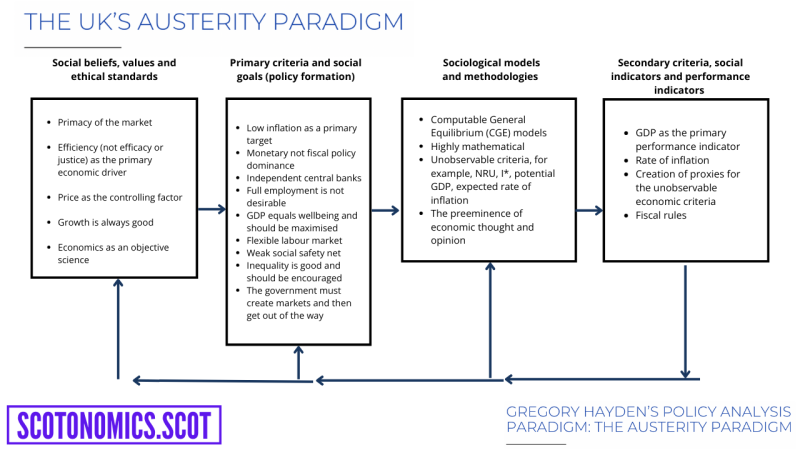
UK Austerity Framework
Let’s look at each column.
Our policy framework is structured on orthodox, or neoclassical or neoliberal economic beliefs. Apart from the late 1940s to early 1970s, this has always been the basis for policy making in the UK.
You can summarise those beliefs as follows:
- The primacy of the market
- Efficiency (not efficacy or justice) as the primary economic driver
- Price as the controlling factor
- Growth is always good
- Economics as an objective science
These can be considered the founding assumptions—the steering wheel of the paradigm. Everything that follows is based on these assumptions, which are unchallengeable in this paradigm.
These assumptions form the basis for general policy guidance. Here are nine areas that shape individual policies and almost naturally lead to austerity.
- Low inflation as a primary target
- Monetary, not fiscal, policy is more useful and important
- Independent central banks
- Full employment is not desirable
- GDP equals wellbeing and should be maximised
- Need a flexible labour market
- Weak social safety net
- Inequality is good and should be encouraged
- The government must create markets and then get out of the way
With these general themes now set, we have to choose a way of understanding if the policies are acting within these confines.
By this stage, we have set the scene for a very particular type of economic narrative. Only one type of economist can usefully support the paradigm at this stage. We need orthodox economists with a gift for mathematical models. This automatically ignores input from specialists from other disciplines. So, we must use certain models with their underlying assumptions (which must match the driving assumptions in the initial column). We are on a fast-moving train by now, and it is impossible to get off.
Finally, we have to measure our success. So:
- GDP as the primary performance indicator
- Rate of inflation
- Creation of proxies for the unobservable economic criteria
- Fiscal rules
Results using these measurements give us success.
Have we increased GDP?
Was the rate of inflation at target?
Have we kept to our debt and deficit targets?
This is the framework under which all policies are made at the central government level. It is also similar at the regional and local levels, but the central government has the ability to dramatically alter the economy.
By now, I hope you can see how ‘natural’ austerity policies become—taking each in turn.
Fiscal austerity is justified as we do not need a social safety net, and full employment is not desirable. Monetary policy (changing the interest rate) should do all the heavy lifting. If we have fiscal targets to meet, then government spending on welfare must fall.
Industrial austerity is justified by the preeminence of the market. If we have a minimum wage, it must be as low as possible. Bullshit jobs – those with no meaningful contract or benefits – should be encouraged.
Finally, monetary austerity means high-interest payments are paid to those with cash to lend. This fits in with monetary policy dominance and the belief that inequality spurs individuals and that only the wealthy have savings.
The system is designed to create austerity in all these three areas. Consider how easily the framework naturally supports any austerity policy.
This institution, the policy framework in the UK, controls the policies that emanate from the central government and are then delivered by subnational and local governments.
To avoid austerity policies, we must first be aware of this institution. We then must expose it and explain it. Only then can we start to understand and challenge austerity. We all must fight against the challenge of changing it.
Those foolish enough to think that austerity would disappear when a labour government took charge did not consider the institution of policy formation in the UK.
As Donella Meadows, one of the founders of system dynamics, said,
Putting different hands on the faucets may change the rate at which the faucets turn, but if they’re the same old faucets, plumbed into the same old system, turned according to the same old information and goals and rules, the system isn’t going to change much.
As we start to see Labour’s austerity agenda being implemented across the UK, we can hopefully understand that changing those in charge of the same levers in the same old system will not end austerity policies.
Progressive commentators and politicians would gain much more traction if they addressed the full scope of austerity. It goes way beyond cutting benefits. It is structural. It is how the system is designed. Point that out, and your message will start to have more impact.
Austerity has been a tragedy for the UK. Understanding the framework and its influence is the first step in dismantling it.
DOWNLOAD OUR BRIEFING NOTE: Explaining Austerity